What California Planners Need To Know About The 21st Century Road To Housing Act

Updated: Sep 15
The 21st Century Road to Housing Act – hailed as a major bipartisan accomplishment – took effect on July 11 over President Trump’s objections but not his veto. Because the federal government plays a limited role in housing production, it’s not likely to have a transformational effect. But several provisions could be important to the planning and development community in Californiaas the state and its cities continue to grapple with the state’s housing affordability crisis.
Among the major provisions are:
-- Funding for jurisdictions that have increased their housing supply;
-- Guidelines and best practices for zoning reform; and
-- Provisions designed to streamline project approval under the National Environmental Policy Act.
-- A 10% penalty in Community Development Block Grant funding if minimum housing production numbers are not met.
NEPA, of course, plays a less important role than the California Environmental Quality Act in California because it applies only to projects undertaken by the federal government or including federal funding.
The law is long and complicated, with many provisions. (You can find the text here.) And the actual impact will be a while coming for two reasons. First, in future years Congress has to actually appropriate the funding called for in the bill. And second, the Department of Housing and Urban Development has to go through a lengthy rulemaking process for virtually every provision. (As the Urban Institute has pointed out, funding cuts have left HUD with limited capacity to engage in rulemaking.)
Here’s a rundown of provisions of interest to the California planning and development community. To avoid confusion, these provisions are listed in the order they appear in the bill – not based on the significance of the provisions to California planners.
Section 102: Guidelines For Single-Stairway Apartment Buildings
This provision calls for “federal guidelines for point-access block buildings”. But don’t get confused – that’s just a fancy term for single-stairway apartment buildings, a major Yimby policy goal. Advocates say it will make building smaller apartment buildings more feasible. Within 18 months, HUD must issue “model code language, best practices, and technical guidelines” to facilitate permitting of single-stairway apartment buildings.
A bill to allow single-stairway apartment buildings (AB 2252) stalled in the California Legislature this year, but some cities such as Culver City have adopted their own single-stairway ordinances. A model ordinance could make it less complicated for other cities to do the same.
Section 103: NEPA Exemption for Rural Infill Housing
This provision exempts some Rural Housing Service projects from NEPA, especially if they are in infill locations. But it is likely to have limited impact in California, as the state has seen almost no Rural Housing Service projects since the early 2010s.
Section 104: Database of Publicly Owned Land
This provision could have some significance for California jurisdictions, especially as housing advocates seek to use public land to “unlock” housing opportunity. Section 104 requires jurisdictions receiving Community Development Block Grant funds – that’s basically everybody – to put a list of vacant sites owned by the jurisdiction on the web. This means California cities and counties will have to daylight the vacant land they own so housing advocates and developers can see the parcels and perhaps put pressure on the jurisdiction to do something with them.
Of course, in California, much of the land owned by cities is underutilized land, not vacant land, and therefore is not covered by this requirement. It will be interesting to see, even in areas closer to the coast, whether counties own significant pieces of vacant land. And, in any event, in California unlocking this land for housing means going through the Surplus Land Act, which comes critics say actually discourages housing production on public land. (See CP&DR’s recent coverage of this controversy here.)
Section 107: Guidelines For Land-Use Policy
Because the federal government does not control local land use decisions, a major effort by both the Biden and Trump Administrations has been focused on finding ways to encourage zoning reform at the local level. For example, the Biden Administration had a major grant program to provide funds for zoning reform.
This section continues the effort along those lines. It requires HUD to prepare best practicers and guidelines for what the law calls zoning “frameworks” – state and local zoning policy regimes that hold the potential to increase housing production. The law calls out many specific policies, such as eliminating parking minimums, reducing setbacks and lot sizes, increasingly by-right approval of “plex” buildings, and encouraging transit-oriented development.
Section 201: Increasing Housing in Opportunity Zones
This provision allows HUD to give extra points for Opportunity Zone projects that include housing.
Section 205: Streamlined NEPA And Environmental Review For Multifamily Projects
This provision allows HUD to downshift environmental review for some federally funded multifamily projects to local governments. But which projects would be included and what the local environmental review would look like won’t be determined under HUD undertakes the rulemaking. So it’s not clear at this point whether CEQA review would suffice – or, for example, whether the “essential project” designation under the Chamber of Commerce CEQA initial would also suffice if that initiative passes.
Section 206: NEPA Streamlining For Small Projects
This provision allows streamlined NEPA review (no environmental assessment – the equivalent of an initial study – and no environmental impact reports) for small projects. The projects include rehabilitation of 1–4 unit buildings, new construction of 5–15 units (and larger scattered-site projects capped at 15 units per site), acquisition or disposition of existing structures, office-to-residential conversions that don't increase the building footprint by more than about 20%, and infill projects generally. But again, this only applies to NEPA, meaning when federal funds are involved.
Section 207: GrantsFor Housing Plans And Zoning Reform
This is a potentially important grant program that California jurisdictions – including regional planning agencies – might be interested in. The law does not specify an amount of funding for this project.
Activities permitted under this project include things like updating zoning codes and updating and improving housing plans and strategies at the state, regional, or local level. Surely some California jurisdictions will seek to obtain funds to update their housing elements. Regional planning agencies are specifically called out as potential recipients of the funds – so it will be interesting to see whether California’s councils of governments seek to use funds to undertake their Regional Housing Needs Allocation process. States are also eligible.
Section 208: $1 Billion For Housing Innovation Grants To Prohousing Jurisdictions
In addition to the grants in Section 207, the law has a section calling on HUD to create a $1 mbillion grant program to jurisdictions that have increased their housing supply in order to support innovation in housing production. It authorizes $200 million a year for five years, though the money still must be appropriated by Congress in the budget each year.
But the law calls on HUD to give priority to jurisdictions that have both implementing innovative programs and increased housing production. Among other things, the law specifies that jurisdictions seeking grants must submit data proving that housing production has gone up. In that sense, the prohousing “rich” will get “richer” under this program. There may be a match with California’s prohousing program, since jurisdictions have already had to prove to the state that they have adopted prohousing policies.
The list of eligible activities is similar to Section 107 (eliminating parking minimums, by-right plex approval, smaller lot size etc.). But activities also include streamlining environmental regulations (would shifting CEQA review to the plan level and facilitating ministerial review of individual projects, a la San Diego, qualify here?) and “minimizing the impact of overburdensome energy and water efficiency standards on housing costs,” which could knock out California jurisdictions that must comply with state law.
Section 213: Penalties and Bonuses for Housing Production
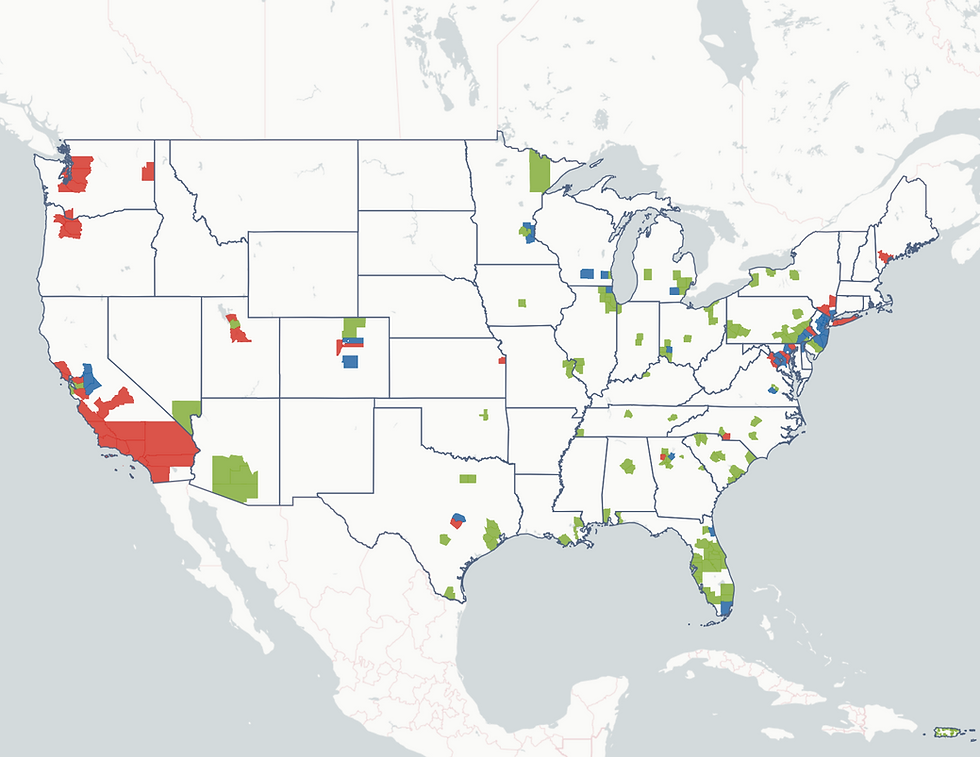
The law also contains penalties and bonuses for housing production. Jursidictions that don't a median housing production target determined by HUD will receive a 10% cut in Community Development Block Grant funds. Jurisdictions that over-produce housing will be eligible for a bonus to be determined by HUD.
Community Scale has created a map showing the likely impact of this provision -- which areas will benefit and which will be penalized -- that suggests California's coastal communities are likely to be penalized.