This article is brought to you courtesy of the paying subscribers to California Planning & Development Report. You can subscribe to CP&DR by clicking here. You can sign up for CP&DR’s free weekly newsletter here.
Push for Potential Home Insurance Ballot Measure Fizzles
Los Angeles advocacy group Consumer Watchdog withdrew its Insurance Policyholder Bill of Rights, which would have required insurers to offer coverage to homeowners who fireproof their homes following the withdrawal of a competing industry measure. The competing measure introduced by brokers, The California Insurance Market Reform and Consumer Protection Act of 2026, would have repealed the law requiring approval of the Insurance Commissioner before raising premium rates. Both sides withdrew their measures, preserving the state’s existing insurance framework in Proposition 103, which gives the elected insurance commissioner authority to reject insurance rate increases. Despite this withdrawal, Consumer Watchdog has vowed to devote the next year to building support for new mandates requiring insurers to sell policies in “higher risk areas”, as insurance companies continue to drop or decline new policies to residents in burn areas. (See related CP&DR coverage.)
Schiff Introduces National Housing Legislation
California Sen. Adam Schiff is proposing the Housing BOOM Act, legislation aimed at expanding affordable housing for low and middle income families through expanded tax credits, a $10 billion annual loan fund, new grants, rental assistance, and funding for homeless shelters. The bill would 1) expand the Low-Income Housing Tax Credit (LIHTC), a stackable tax credit which would inject the financial capital needed to spur the development of more affordable housing projects; 2) establish new programs through HUD to support middle-income and workforce housing, including a $10 billion annual loan fund and a $5 billion annual block grant program to expand affordable housing options for families earning 60-120% of Area Median Income; increase funding for HUD assisted housing programs supporting the development of affordable housing for rural and tribal communities and seniors and people with disabilities; convert underutilized hotels and public buildings into housing through creation of a federal grant program for state and local governments to facilitate these conversion projects. The legislation would also create a $10 billion annual loan fund and a $5 billion annual grant program targeted at middle-income housing development.
High Speed Rail Analyzes Southernmost Segment: L.A. to Anaheim
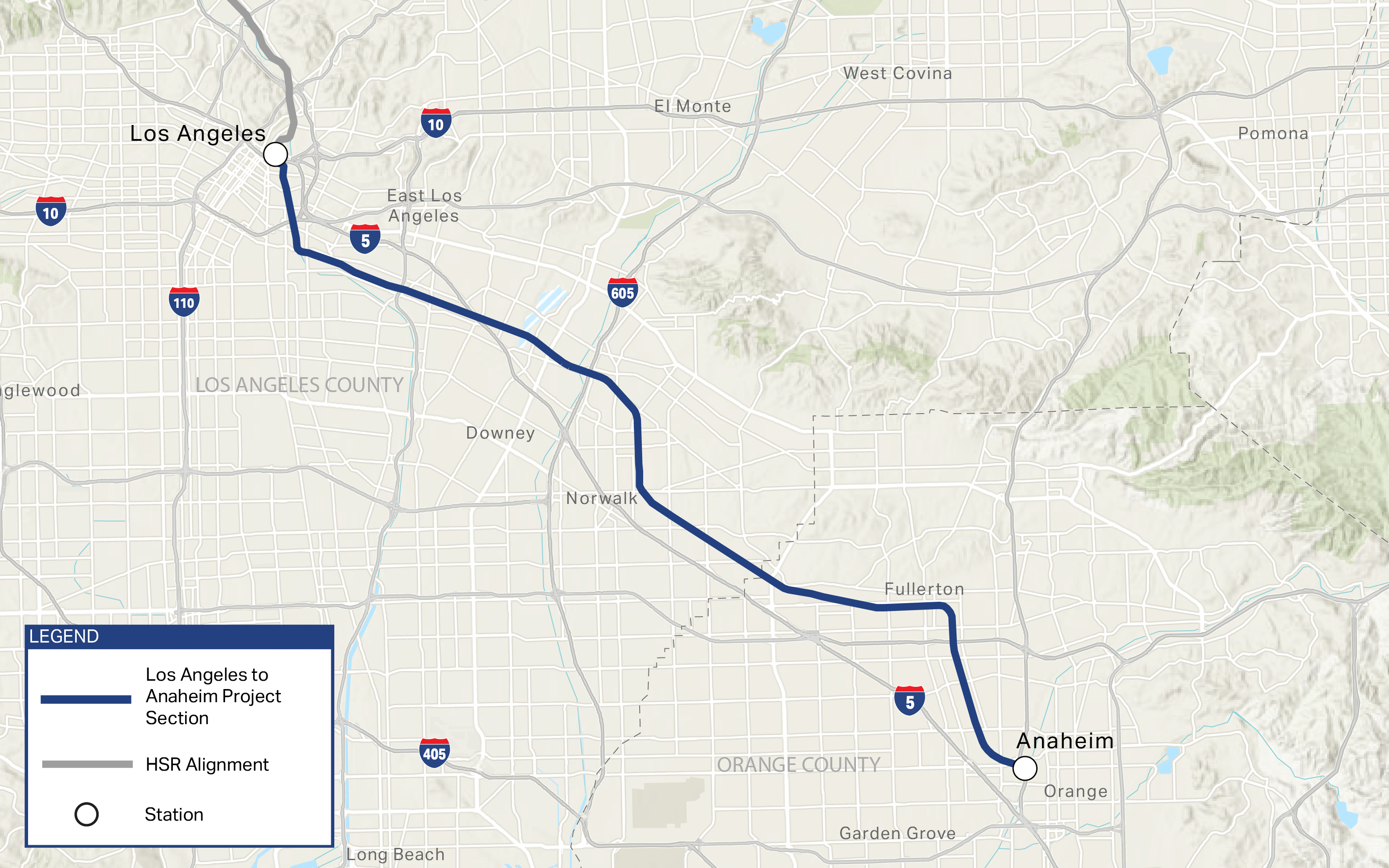
The California High-Speed Rail Authority released the Draft Environmental Impact Report/Environmental Impact Statement for a planned 30-mile rail segment between Downtown Los Angeles and Anaheim, representing a step towards full environmental approval. A public comment period is now open until February 3. The segment planned segment would link LA's Union Station and the Anaheim Regional Transportation Intermodal Center, using the existing freight and passenger rail corridor. As of the announcement, construction is currently underway on the 171-mile initial Merced-Bakersfield line of the planned high-speed rail project, and 463 miles of the 494 total miles of the planned Los Angeles-San Francisco system have been fully approved.
The California High-Speed Rail Authority released the Draft Environmental Impact Report/Environmental Impact Statement for a planned 30-mile rail segment between Downtown Los Angeles and Anaheim, representing a step towards full environmental approval. A public comment period is now open until February 3. The segment planned segment would link LA's Union Station and the Anaheim Regional Transportation Intermodal Center, using the existing freight and passenger rail corridor. As of the announcement, construction is currently underway on the 171-mile initial Merced-Bakersfield line of the planned high-speed rail project, and 463 miles of the 494 total miles of the planned Los Angeles-San Francisco system have been fully approved.
State Gains New "Cultural Districts"
The California Arts Council has designated 10 new California Cultural Districts, which recognize local creativity, diversity, and unique identities. The newest state-designated cultural districts include areas in San Francisco, Riverside, San Diego, Alameda, Stanislaus, Merced, Ventura, Los Angeles, Santa Clara and Santa Cruz counties. The designation brings state recognition, $10,000 over a two-year period, technical assistance, and access to joint marketing and branding resources. The announcement of these new districts comes just after the release of The Future of California Is Creative, a strategic plan for supporting the creative economy in the state. The program helps communities harness cultural assets to stimulate local economies, attract tourism, preserve historic sites, and support vibrant, inclusive creative economies.
CP&DR Coverage: Santa Barbara Developer Sues in Federal Court, Claiming It Is Singled Out By New State Law
A Santa Barbara developer with a pending builder’s remedy project has sued the state in federal court, claiming a new law violates the developer’s constitutional rights. The root of the lawsuit is a proposal by The Mission LLC to build an eight-story housing project behind the iconic Santa Barbara Mission. Under AB 130, passed last summer, infill housing projects of up to 20 acres are exempt from the California Environmental Quality Act, but under SB 158, passed later in the session and signed by Gov. Gavin Newsom, the infill exemption cannot be applied to the Santa Barbara project. The main argument in the new lawsuit is that SB 158 singles out the project’s developer in a way that violates both the federal and state constitutions, most notably the equal protection clause and the so-called “prohibition on special legislation” in the state constitution, which prohibits passing laws that target specific individuals or corporations. The developer’s lawsuit also names the City of Santa Barbara as a defendant, claiming that the city’s overlay zone does not conform with state Housing Element law. The overlay claim builds on a recent appellate court ruling from Redondo Beach.
A Santa Barbara developer with a pending builder’s remedy project has sued the state in federal court, claiming a new law violates the developer’s constitutional rights. The root of the lawsuit is a proposal by The Mission LLC to build an eight-story housing project behind the iconic Santa Barbara Mission. Under AB 130, passed last summer, infill housing projects of up to 20 acres are exempt from the California Environmental Quality Act, but under SB 158, passed later in the session and signed by Gov. Gavin Newsom, the infill exemption cannot be applied to the Santa Barbara project. The main argument in the new lawsuit is that SB 158 singles out the project’s developer in a way that violates both the federal and state constitutions, most notably the equal protection clause and the so-called “prohibition on special legislation” in the state constitution, which prohibits passing laws that target specific individuals or corporations. The developer’s lawsuit also names the City of Santa Barbara as a defendant, claiming that the city’s overlay zone does not conform with state Housing Element law. The overlay claim builds on a recent appellate court ruling from Redondo Beach.
Quick Hits & Updates
Los Angeles City Council halted a proposal to study a climate resilience district in Pacific Palisades over concerns whether a recently affected burn area should serve as an appropriate testing ground for a novel financing tool. The proposal would have created LA’s first Climate Resilience District, a designation which could help direct future local revenues toward climate-related studies and improvements.
Over the summer, the Trump administration shuttered, without announcement, a $400 million project to transform a defunct naval base in Alameda into an outpatient clinic and columbarium for veterans. Mayor Marilyn Ezzy Ashcraft says that city officials received no prior warning to the shutdown, finding out the clinic by way of a Veterans Administration memo that was sent to some members of congress in August.
The Department of Fish and Wildlife has recommended granting Southern California mountain lions threatened species status, citing freeways, rat poison and wildfires as a threat to the population of roughly 1,400.
San Francisco officials in Mayor Daniel Lurie’s office proposed a parcel tax to address a $307 million annual budget deficit that threatens to send Muni, the city’s local transit, into financial collapse. The tax aims to spare middle-class households and small businesses by splitting the parcel tax into three groups scaled by income, with 96% of single-family homeowners paying a flat fee of $129 annually.
The Tribal Council of the Colorado River Indian Tribes has recognized the Colorado River as a legal person under tribal law, marking the second such recognition after the Yurok Tribe recognized the Klamath as a person in 2019. The decision was taken, after community input from trial members, in order to help better recognize the river's welfare when planning for the future of water usage and preservation regarding the river.
The California High-Speed Rail Authority released the Draft Environmental Impact Report/Environmental Impact Statement for a planned 30-mile rail segment between Downtown Los Angeles and Anaheim, representing a step towards full environmental approval. A public comment period is now open until February 3. The segment planned segment would link LA's Union Station and the Anaheim Regional Transportation Intermodal Center, using the existing freight and passenger rail corridor.
The California High-Speed Rail Authority released the Draft Environmental Impact Report/Environmental Impact Statement for a planned 30-mile rail segment between Downtown Los Angeles and Anaheim, representing a step towards full environmental approval. A public comment period is now open until February 3. The segment planned segment would link LA's Union Station and the Anaheim Regional Transportation Intermodal Center, using the existing freight and passenger rail corridor.
Attorney Robert Silverstein, who famously opposed development in Hollywood, died November 13 at the age of 57. For over two decades, Silverstein advocated for more scrutiny in the city planning department’s review of new real estate projects in legal battles including halting of construction of a Target on Sunset Boulevard and the overturning of the city’s approval of the Millennium project, a pair of skyscrapers that had been planned next to the Capitol Records building. (See related CP&DR coverage.)
San Jose city council approved a plan to streamline the approval process for housing development and renovation projects on vacant or underused lots. This process eliminated the need for public hearings or CEQA reviews provided the projects meet a list of certain criteria, prioritizing construction of mixed-use commercial and urban residential projects.
The San Francisco Downtown Development Corporation has received over $60 million in funding from donors including Google and OpenAI. The nonprofit public benefit corporation was launched in April by Mayor Daniel Lurie with the goal of reviving San Francisco’s city center.
The developers of Midway Rising, a proposed plan for 4,200 apartments with 2,000 rent-capped, 14 acres of public space and a sports stadium in San Diego's Midway District, say they are undeterred by a an appeals court's recent overturning of a city election vote to remove Midway's 30-foot height limit. The developers say the court ruling does not affect mixed-use housing developments, which are governed by state density bonus law.
The developers of Midway Rising, a proposed plan for 4,200 apartments with 2,000 rent-capped, 14 acres of public space and a sports stadium in San Diego's Midway District, say they are undeterred by a an appeals court's recent overturning of a city election vote to remove Midway's 30-foot height limit. The developers say the court ruling does not affect mixed-use housing developments, which are governed by state density bonus law.