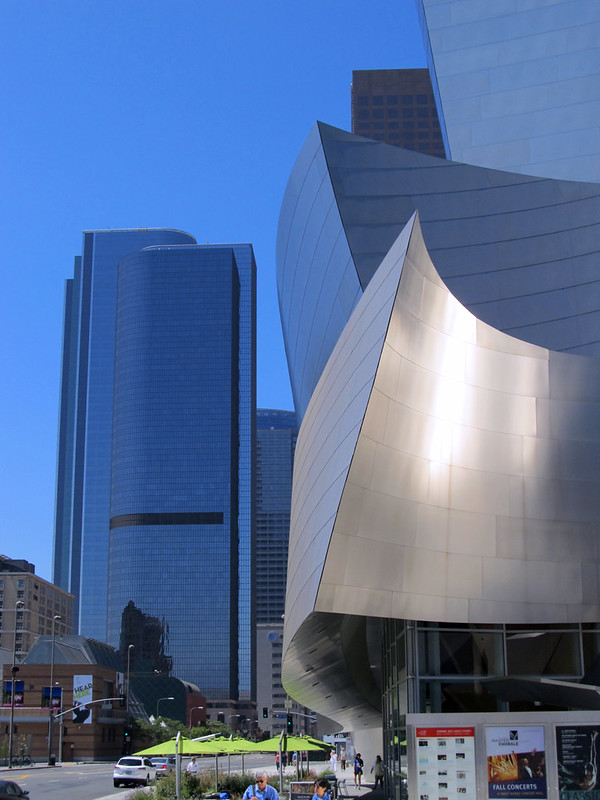
A few blocks south on Grand Avenue from Bunker Hill a titanium dagger protrudes over the sidewalk. The blade captures the sunlight and hints at something terribly interesting, beckoning you to walk closer and find out about the carcass into which it is plunged.
That’s my favorite view of Disney Hall. Or, rather, it’s my favorite view of Los Angeles that has Disney Hall in it. It’s where the structure and the city fuse together.
Was Frank Gehry, arguably the most famous of the starchitects, an urbanist? He was urban, for sure.
Almost all of his buildings are located in cities, with more in Los Angeles than any other. But, did he love cities? Did he want to make them better? Or were they simply canvases for his art--gardens for his sculptures?
The answer is yes. But, as with most things Gehry, it’s a twisty, turny yes.
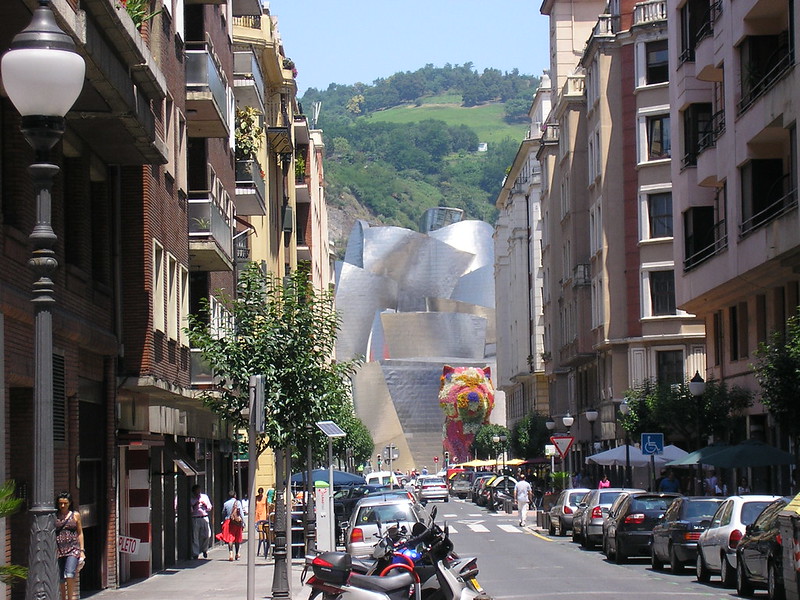
They call it the "Bilbao effect"—not the Gehry effect—for a reason: the sudden brilliance of the Guggenheim in that Spanish city, which opened in 1997, lies not only in its form but also in its site. Gehry deserves credit for realizing that his indescribable swoops could coexist in equal parts tension and harmony with Bilbao's dark old streets -- and in a city that had been long forgotten. He recognized that a city makes history visible, and the Guggenheim owes its greatness as much to its surroundings as to its blueprint.
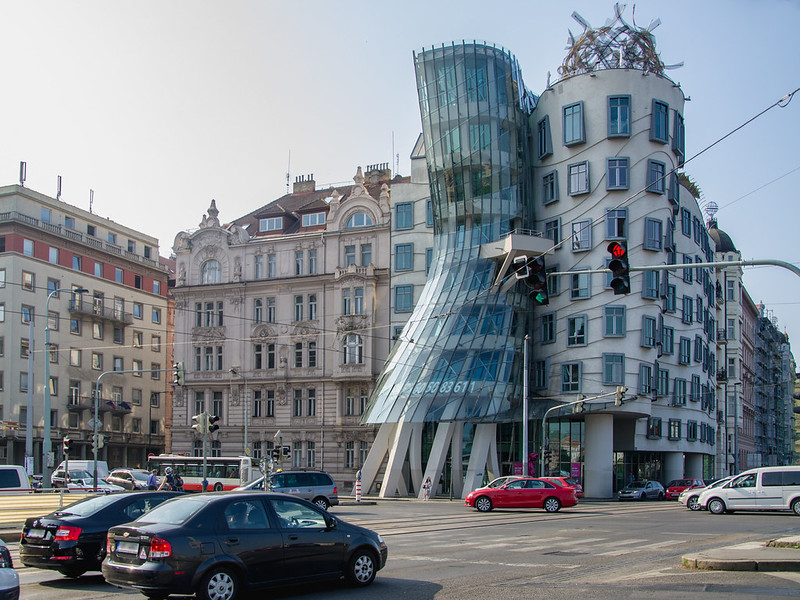
This relationship between new and old lies at the heart of a more subtle but still lovely Gehry design: so-called Fred and Ginger. They dance not so much with each other but with all of Prague and indeed the whole of Europe and all the horror, joy, progress, and regret that passed through it between the 18th and 20th centuries. That spirit extends
back to Gehry’s own house, set on a pleasant street of modest wealth in Santa Monica, where the violence of chain link, corrugated metal, and odd angles interrupts the semi-suburban hush.
Gehry’s most important contributions were visual. Though he designed them long before the age of Instagram, many of Gehry’s buildings are exuberantly photogenic, intended to be looked at as much as occupied. Whether you appreciate it by coming around a corner in Prague or by stepping back and getting hit by a bus on Grand Avenue isn’t Gehry’s problem.
Gehry is an urbanist because he knew, uncannily, exactly what Bilbao needed. It didn’t need walkable streets. It didn’t need history. It didn’t need density and mixed use. It had all of that. It needed excitement. It needed to be brought out of its industrial malaise and into the 21st century.
Gehry’s aesthetic plays out differently in Los Angeles.
Some of his early work was communal: Santa Monica Place mall, which has been renovated beyond recognition; Loyola Law School, and the Edgemar retail complex in Santa Monica. His private homes are wonderful but secreted: compounds of multiple buildings that are, in many ways, anti-mansions. For a while, he worked on the Los Angeles River Master Plan. The river will run with ambrosia before it or anyone else’s vision becomes reality. And, recently, he (or his firm) designed a highly lauded facility for the nonprofit Youth Orchestra of Los Angeles in Inglewood. (Arguably, though, his greatest civic structure is the Pritzker Pavilion in Chicago.)
He never designed streetscapes, public plazas, transit stations, schools, or anything else in the public realm.
My most cynical appraisal is that many of Gehry’s buildings are baubles: complex, showy, apolitical, expensive, precious, sometimes breathtaking. They are visually irresistible, inside and out. And yet, all the crescendos in the world cannot not change how barren Grand Avenue feels once the baton has fallen and midnight approaches.
However much Frank Gehry gave or did not give to LA, but he was undeniably of L.A. Though he was born in Toronto, Los Angeles gave Gehry, along with a group of a half-dozen other young (white, male) architects of the 1970s the freedom, and the money, to experiment in ways that perhaps no other city could have at the time. L.A.’s built environment was so haphazard and, let’s be honest, ugly, that Gehry’s odd angles and industrial materials, which surely would have been dismissed as ugly or sloppy anyplace else, were A-OK.
The real question is, did Gehry do enough?
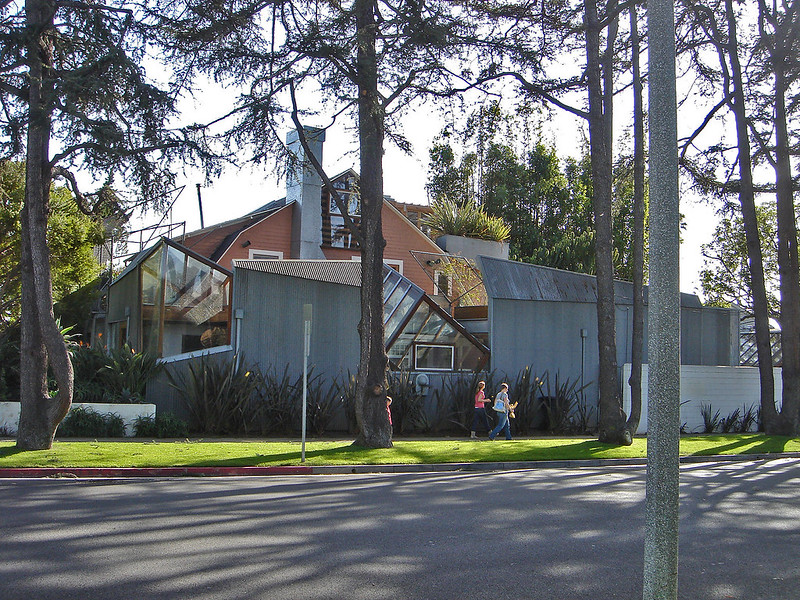
He was a private citizen, entitled to do whatever he wanted with his talent, influence, and (presumably) wealth. Aligning himself with wealthy clients -- individuals and foundations alike -- is good business. And yet, among all living architects, nobody had a higher profile and, therefore, a greater capacity for doing good. In that sense, Gehry was as aloof as his buildings are energetic. He was more artiste than civic entrepreneur.
Gary embodies the fundamental paradox of Los Angeles. It produces incredible works of creativity while it, in its totality, is neither creative nor attractive. We need less Guggenheim and more Bilbao. And that requires planning.
Planning reaches into the lives and spaces of literally every stakeholder in a city. And yet, it’s invisible and mostly anonymous. With all due respect to Bertoni, Dennis-Philip, and Vonblum -- all big-city planning directors, none of whom is a household name -- the Burnhams, Haussmans, and L’Enfants are the exceptions that prove the rule. Granted, an entire city designed by someone like Gehry — swoops, shiny, wholly off-kilter — would induce millions of cases of vertigo. We don’t want that, and I doubt he did either.
It doesn’t need “grand” boulevards; it needs streets, alleys, passageways, and plazas. It needs stores, sidewalk cafes, and dense, cheap housing that does not insult its occupants, no matter their income level. It needs trees, awnings, and, for the love of god, bus shelters. It needs craftsmanship, not high design.
We can celebrate Gehry, and we can mourn his passing. But Gehry is not what we need most.
Image Credits
Bilbao: Nigel Swales via Flickr
Disney Hall: Daryl Mitchell via Flickr.
House: IK's World Trip via Flickr